Black & White Fine Art Photography Prints
Black and white fine art photography that foregrounds contrast, silhouette, and graphic structure. Downtown Los Angeles at dusk. The Freedom Tower caught in reflection. Lady Liberty framed against open sky.
These monochrome prints by award-winning photographer Glen Wilbert strip scenes to shape and tonal contrast — the same compositional rigor applied through a different lens. Glen's black-and-white work has earned recognition including a Bronze Medal in the Travel Category at the reFocus Black and White Photo Contest. Available as framed canvas prints in sizes from 8×10 to 24×36 inches. Each print is produced on archival-weight canvas with a pine tree frame and floating effect, ready to hang. A striking choice for modern interiors, home offices, and gallery walls.
Award-Winning Photography · 30+ Juried Exhibitions · Archival-Quality Canvas · Ready to Hang · Ships Worldwide
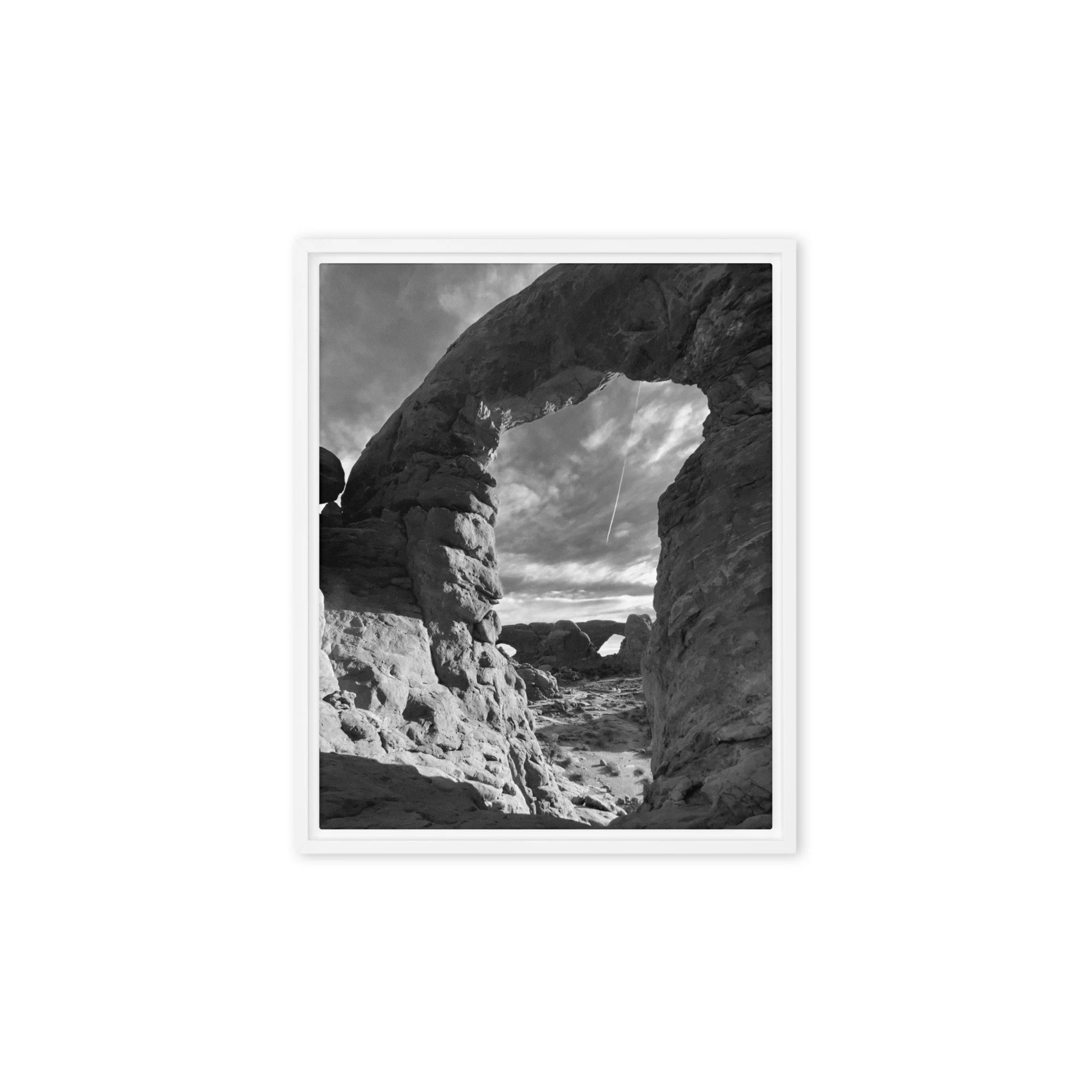
In "Arches," Glen Wilbert photographs the Windows section of Arches National Park in eastern Utah, shooting a large sandstone arch from below, with a smaller arch visible through the opening in the distance and a single jet contrail crossing the framed patch of sky.
The image is rendered in black and white, which emphasizes the texture of the eroded rock against the smooth, cloud-streaked sky. The dark mass of the stone occupies most of the frame, with the bright opening at its center drawing the eye through to the second arch and the desert floor beyond. Rather than photographing the arch head-on, Glen shot it from the ground looking up, positioning the camera so that one arch frames another behind it. The contrail adds a thin diagonal line across the sky and marks the specific moment the photograph was taken.
The park contains more than 2,000 natural stone arches, formed over millions of years as water and wind eroded the sandstone. This is one of the most visited sites in the American Southwest and a regular stop on road trips through the region.
In black and white, the composition is built on contrast and silhouette: the heavy, textured rock set against open sky.
Awards and Recognition
Glen Wilbert's work has earned national recognition, including First Place at the 2024 iPhone Photography Awards, multiple Gold Medals at the reFocus Awards, and selection for more than thirty juried exhibitions across the United States.
Details
• Framed canvas print, pine wood frame with a floating-frame effect
• Frame thickness: 1.25 in (3.18 cm)
• Canvas weight: approximately 344 g/m2
• White frame with a white inner border around the canvas
• Open back, rubber corner pads, hanging hardware attached
• Printed and framed in the USA
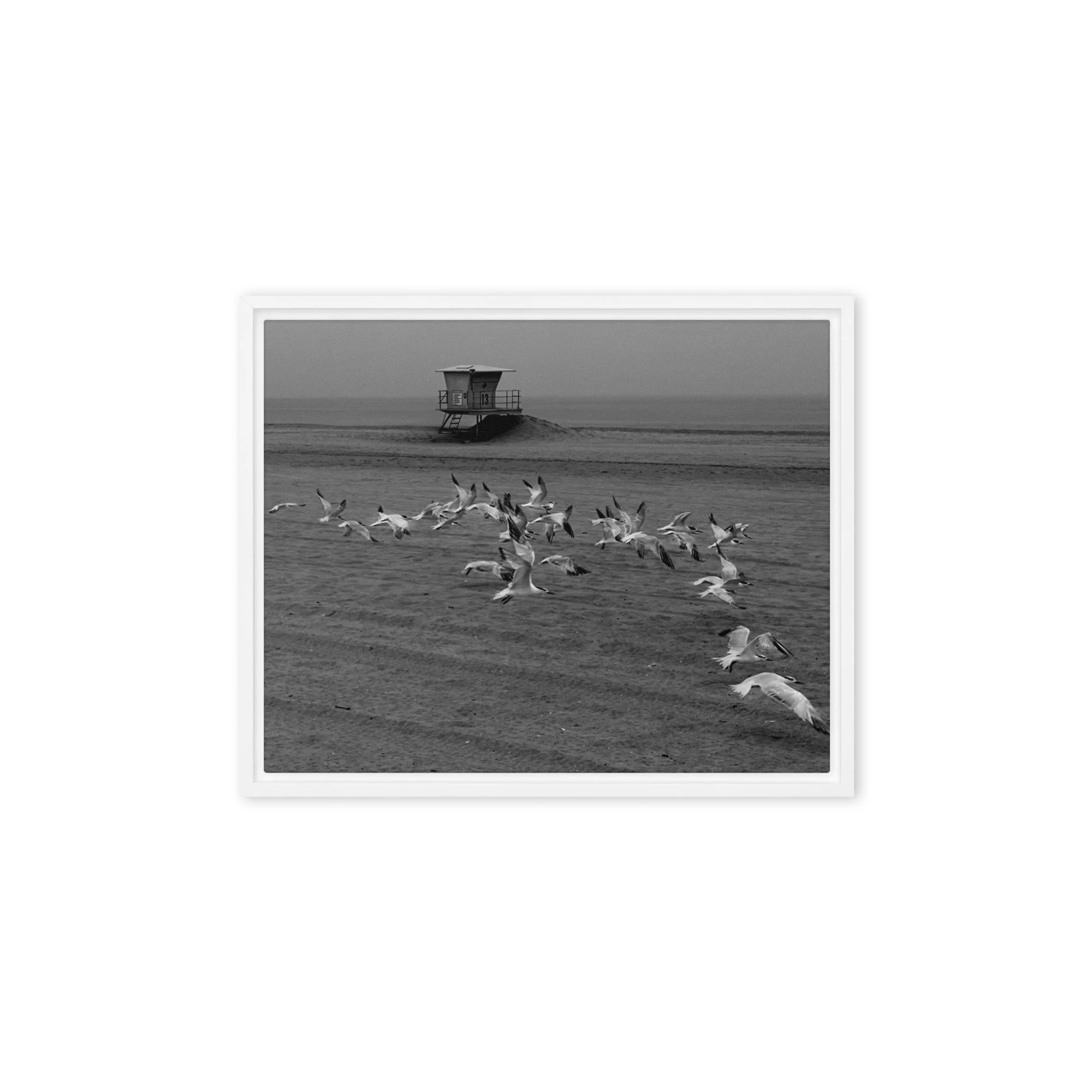
In "Birds of a Feather, Southern California," Glen Wilbert photographs a flock of gulls lifting off a wide beach at low light, their spread wings caught in mid-motion, with a numbered lifeguard tower and the flat ocean horizon behind them.
The image is rendered in black and white, with the pale birds standing out sharply against the dark, raked sand. Glen caught the flock at the instant of takeoff, wings open and bodies scattered across the lower half of the frame in a loose diagonal that leads back toward the tower. The smooth gray sky and still sea behind give the busy, moving birds a calm backdrop, setting motion against stillness.
The scene is an early-morning or dusk moment on the Southern California coast, with the lifeguard tower marking the location. This is an example of what Glen describes as the decisive moment, a fleeting organization of pattern and motion captured before it scatters.
In black and white, the composition is built on motion and contrast: the bright, moving birds against dark sand and quiet sky.
Awards and Recognition
Glen Wilbert's work has earned national recognition, including First Place at the 2024 iPhone Photography Awards, multiple Gold Medals at the reFocus Awards, and selection for more than thirty juried exhibitions across the United States.
Details
• Framed canvas print, pine wood frame with a floating-frame effect
• Frame thickness: 1.25 in (3.18 cm)
• Canvas weight: approximately 344 g/m2
• White frame with a white inner border around the canvas
• Open back, rubber corner pads, hanging hardware attached
• Printed and framed in the USA
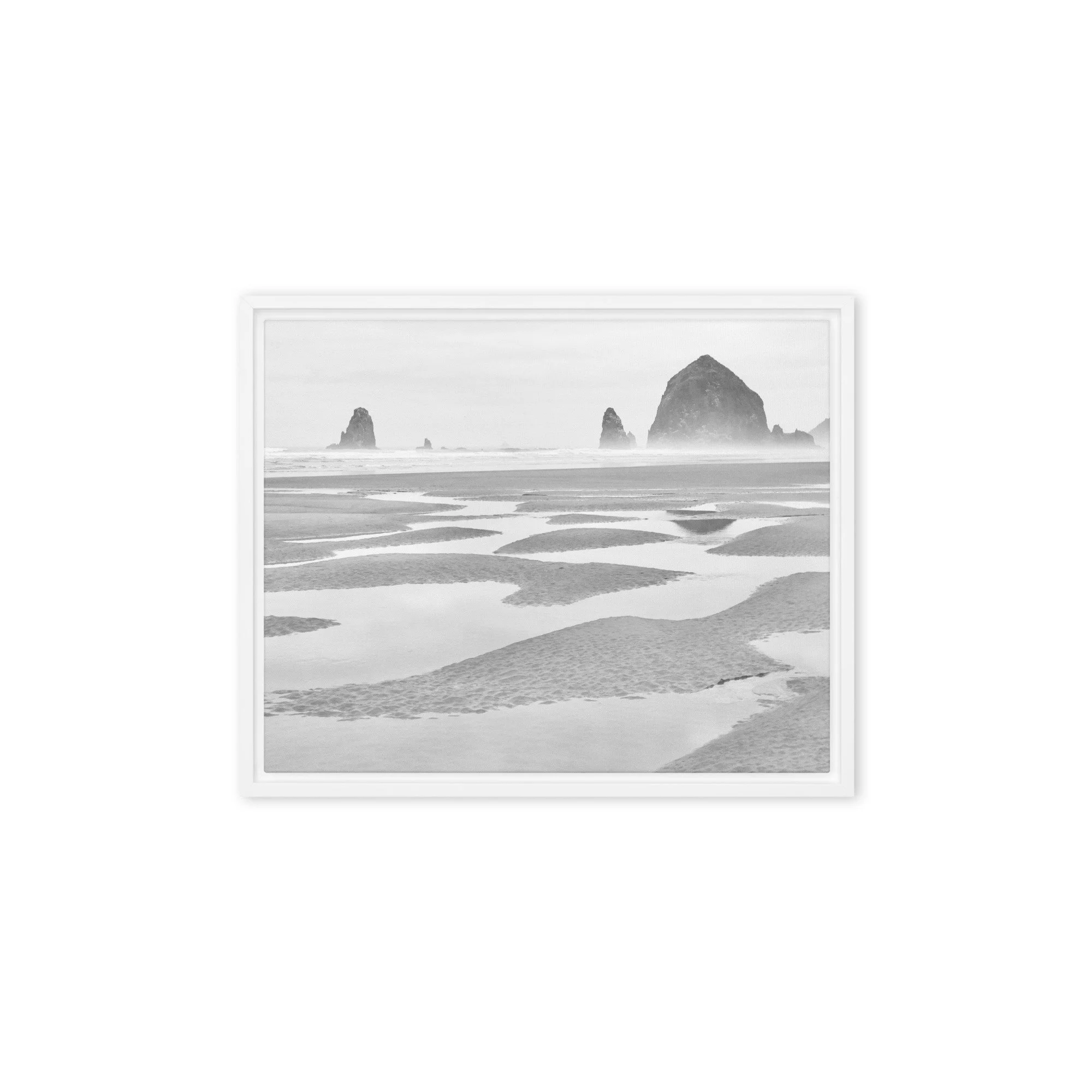
In "Cannon Beach Reflections," Glen Wilbert photographs Haystack Rock and the smaller sea stacks at Cannon Beach, Oregon, with the foreground given over to a pattern of shallow tide pools and wet sand at low tide.
The image is rendered in black and white and built in two parts: the misty rock formations along the upper horizon, and the large foreground of irregular tide pools that form a map-like pattern of light water and darker sand. Glen positioned the camera low and back so the pools lead the eye across the frame toward Haystack Rock, which sits softened by coastal haze. The result emphasizes the shapes the receding tide leaves behind as much as the famous rock itself.
Haystack Rock is one of the most recognizable landmarks on the Oregon coast and a frequent stop on Pacific Northwest road trips. Glen treats it as one element in a larger study of pattern and tone rather than the sole subject.
In black and white, the composition is built on pattern and tonal contrast: the bright pools and dark sand beneath the soft mass of the rock.
Awards and Recognition
Glen Wilbert's work has earned national recognition, including First Place at the 2024 iPhone Photography Awards, multiple Gold Medals at the reFocus Awards, and selection for more than thirty juried exhibitions across the United States.
Details
• Framed canvas print, pine wood frame with a floating-frame effect
• Frame thickness: 1.25 in (3.18 cm)
• Canvas weight: approximately 344 g/m2
• White frame with a white inner border around the canvas
• Open back, rubber corner pads, hanging hardware attached
• Printed and framed in the USA
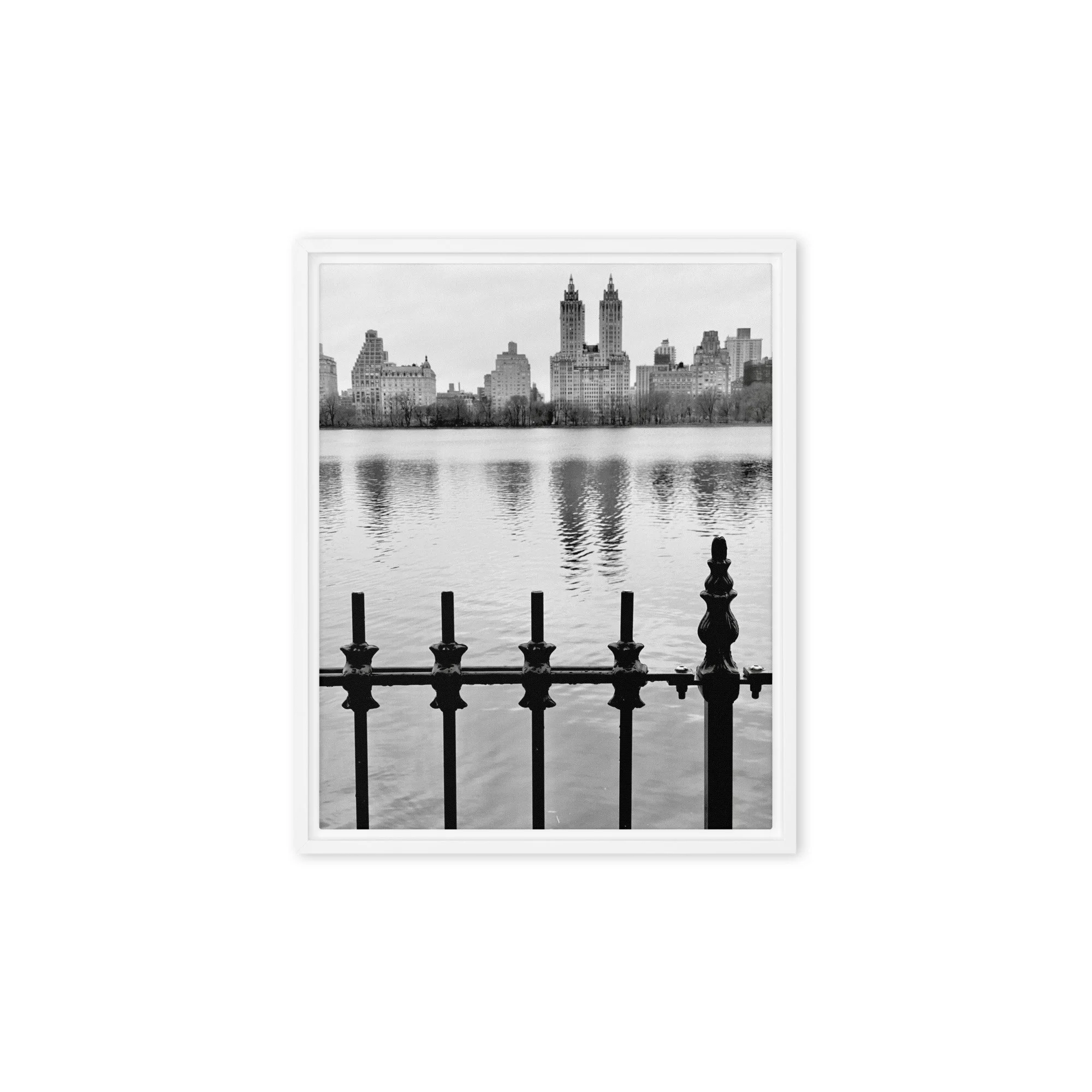
In "Central Park," Glen Wilbert photographs the Jacqueline Kennedy Onassis Reservoir in New York's Central Park, looking across the water to the Upper West Side skyline, with a wrought-iron fence running along the bottom of the frame.
The image is rendered in black and white and arranged in clear horizontal layers: the dark iron fence in the foreground, the still water of the reservoir, the bare winter trees along the far bank, and the apartment buildings rising behind, including the twin-towered San Remo. The decorative finial of the fence sits at right, slightly closer to the camera, giving the flat scene a point of depth. The calm water holds soft reflections of the skyline.
The reservoir and its running track are among the most familiar settings in Central Park, ringed by the landmark apartment buildings of Manhattan. Glen frames the view through the historic cast-iron fence, using it to anchor the composition.
In black and white, the composition is built on layering and silhouette: the dark fence set against the soft gray skyline and water.
Awards and Recognition
Glen Wilbert's work has earned national recognition, including First Place at the 2024 iPhone Photography Awards, multiple Gold Medals at the reFocus Awards, and selection for more than thirty juried exhibitions across the United States.
Details
• Framed canvas print, pine wood frame with a floating-frame effect
• Frame thickness: 1.25 in (3.18 cm)
• Canvas weight: approximately 344 g/m2
• White frame with a white inner border around the canvas
• Open back, rubber corner pads, hanging hardware attached
• Printed and framed in the USA
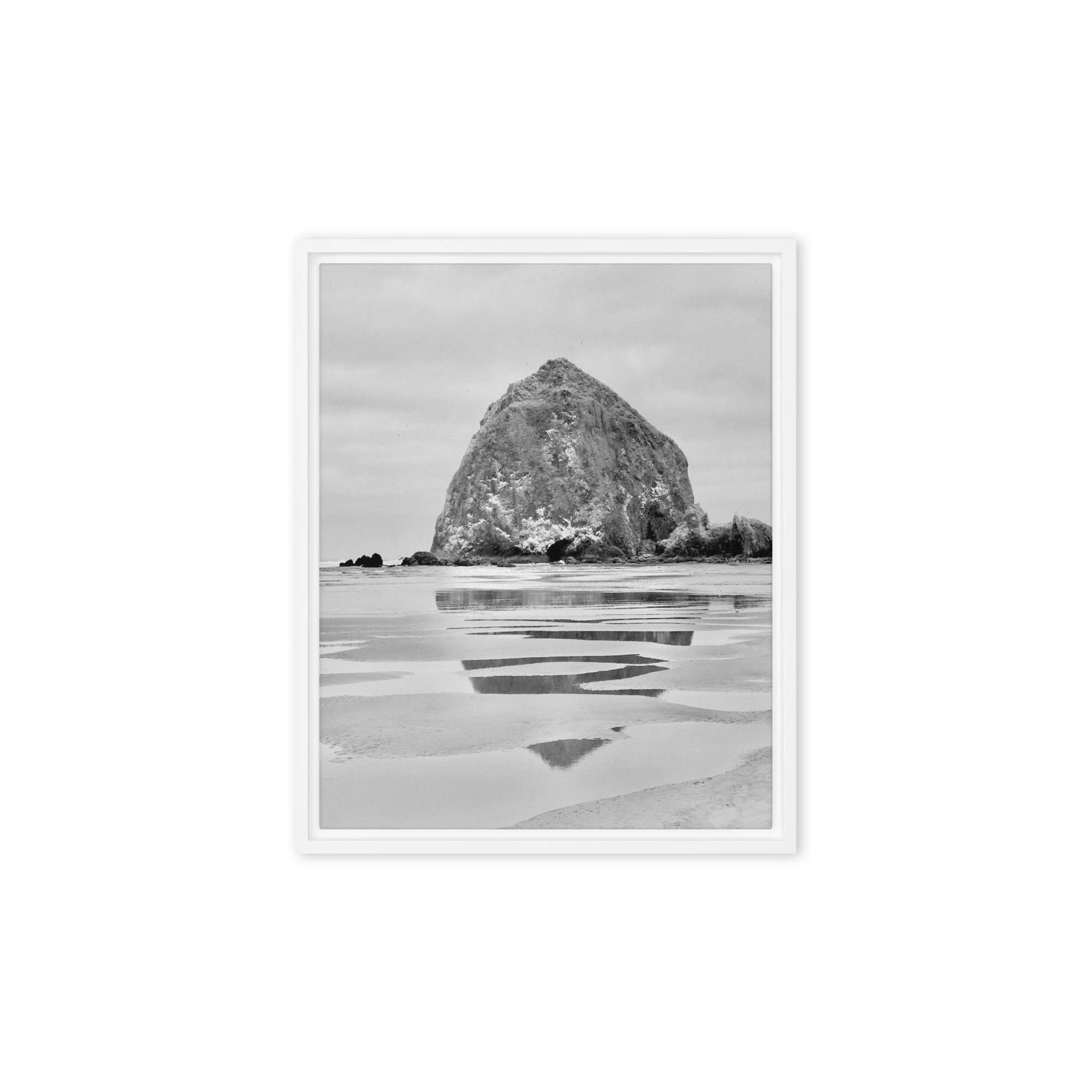
In "Reflecting on Cannon Beach," Glen Wilbert photographs Haystack Rock at Cannon Beach, Oregon, the large sea stack rising from the surf while its shape is mirrored on the smooth wet sand of the foreground at low tide.
The image is rendered in black and white, with the dark mass of Haystack Rock centered on the horizon and its reflection stretching toward the camera across the shining flats. Glen framed the scene so the patches of mirror-like wet sand and shallow pools break the foreground into soft reflective shapes, repeating the rock's silhouette in pale gray. The overcast sky keeps the tones even and quiet, focusing attention on the contrast between the solid rock and its broken reflection.
Haystack Rock is the signature landmark of the Oregon coast and a frequent stop on Pacific Northwest road trips. This is a closer, reflection-focused companion to Glen's other Cannon Beach image, here giving the mirrored sand the leading role.
In black and white, the composition is built on silhouette and reflection: a dark sea stack and its pale echo on the wet sand.
Awards and Recognition
Glen Wilbert's work has earned national recognition, including First Place at the 2024 iPhone Photography Awards, multiple Gold Medals at the reFocus Awards, and selection for more than thirty juried exhibitions across the United States.
Details
• Framed canvas print, pine wood frame with a floating-frame effect
• Frame thickness: 1.25 in (3.18 cm)
• Canvas weight: approximately 344 g/m2
• White frame with a white inner border around the canvas
• Open back, rubber corner pads, hanging hardware attached
• Printed and framed in the USA
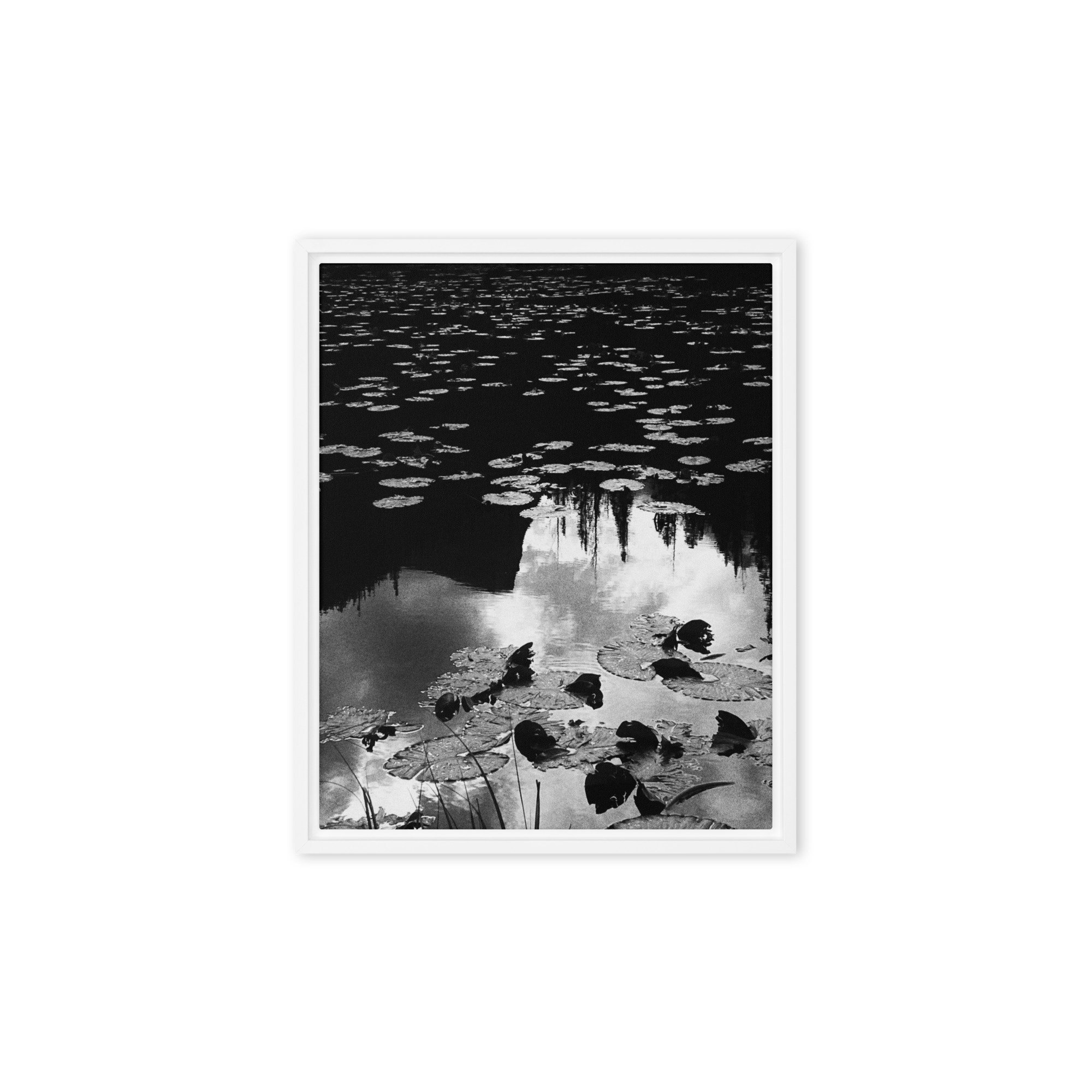
In "Lily Pad Reflections, Colorado," Glen Wilbert photographs a still pond covered with lily pads, framing the dark water so that the pads scatter across the surface and a bright patch of reflected sky and trees opens in the lower center.
The image is rendered in black and white, with the water reading nearly black at the top and the lily pads appearing as pale, repeating shapes across it. Glen tilted the view down onto the surface so there is no horizon, only the flat plane of the pond, the floating pads, and the mirrored reflection of clouds and dark trees breaking through near the foreground. A few reeds rise at the bottom edge. The contrast between the inky water and the silver reflection gives the picture its structure.
The image was made on a pond in Colorado and treats a quiet natural scene as a study in pattern and tone. It carries an echo of Monet's water-lily subjects, here rendered in stark black and white rather than color.
In black and white, the composition is built on pattern and tonal contrast: pale pads and bright reflection set against near-black water.
Awards and Recognition
Glen Wilbert's work has earned national recognition, including First Place at the 2024 iPhone Photography Awards, multiple Gold Medals at the reFocus Awards, and selection for more than thirty juried exhibitions across the United States.
Details
• Framed canvas print, pine wood frame with a floating-frame effect
• Frame thickness: 1.25 in (3.18 cm)
• Canvas weight: approximately 344 g/m2
• White frame with a white inner border around the canvas
• Open back, rubber corner pads, hanging hardware attached
• Printed and framed in the USA
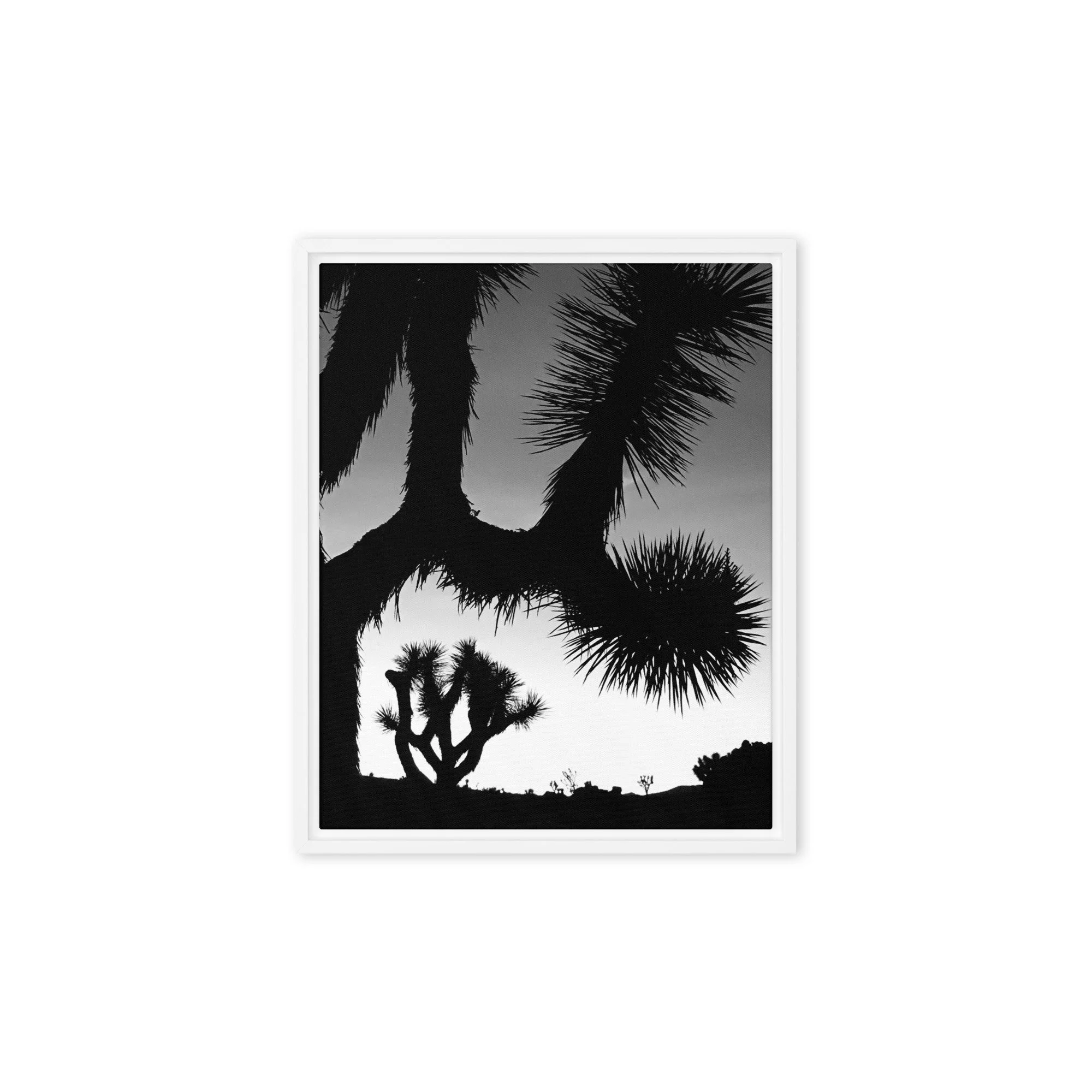
In "Sunset, Joshua Tree," Glen Wilbert photographs Joshua trees silhouetted against the dusk sky, the spiky arms and trunks of the nearest tree filling the upper frame in stark black while a smaller tree stands on the horizon below.
The image is rendered in high-contrast black and white, with the Joshua trees reduced to pure black silhouettes against a smooth gradient of pale gray sky. Glen framed the scene from below and close so the branching arms and bristling spikes of the foreground tree spread across the top like a canopy, while the lone tree on the distant ridge anchors the lower center. The complete loss of detail in the shadows turns the desert plants into bold graphic shapes.
Joshua Tree National Park, where the Mojave and Colorado deserts meet, is named for these trees. This is the black-and-white companion to Glen's pastel Joshua tree image, trading soft color for stark silhouette and graphic contrast.
In black and white, the composition is built on silhouette and shape: the spiked black forms of the trees against a pale, empty sky.
Awards and Recognition
Glen Wilbert's work has earned national recognition, including First Place at the 2024 iPhone Photography Awards, multiple Gold Medals at the reFocus Awards, and selection for more than thirty juried exhibitions across the United States.
Details
• Framed canvas print, pine wood frame with a floating-frame effect
• Frame thickness: 1.25 in (3.18 cm)
• Canvas weight: approximately 344 g/m2
• White frame with a white inner border around the canvas
• Open back, rubber corner pads, hanging hardware attached
• Printed and framed in the USA
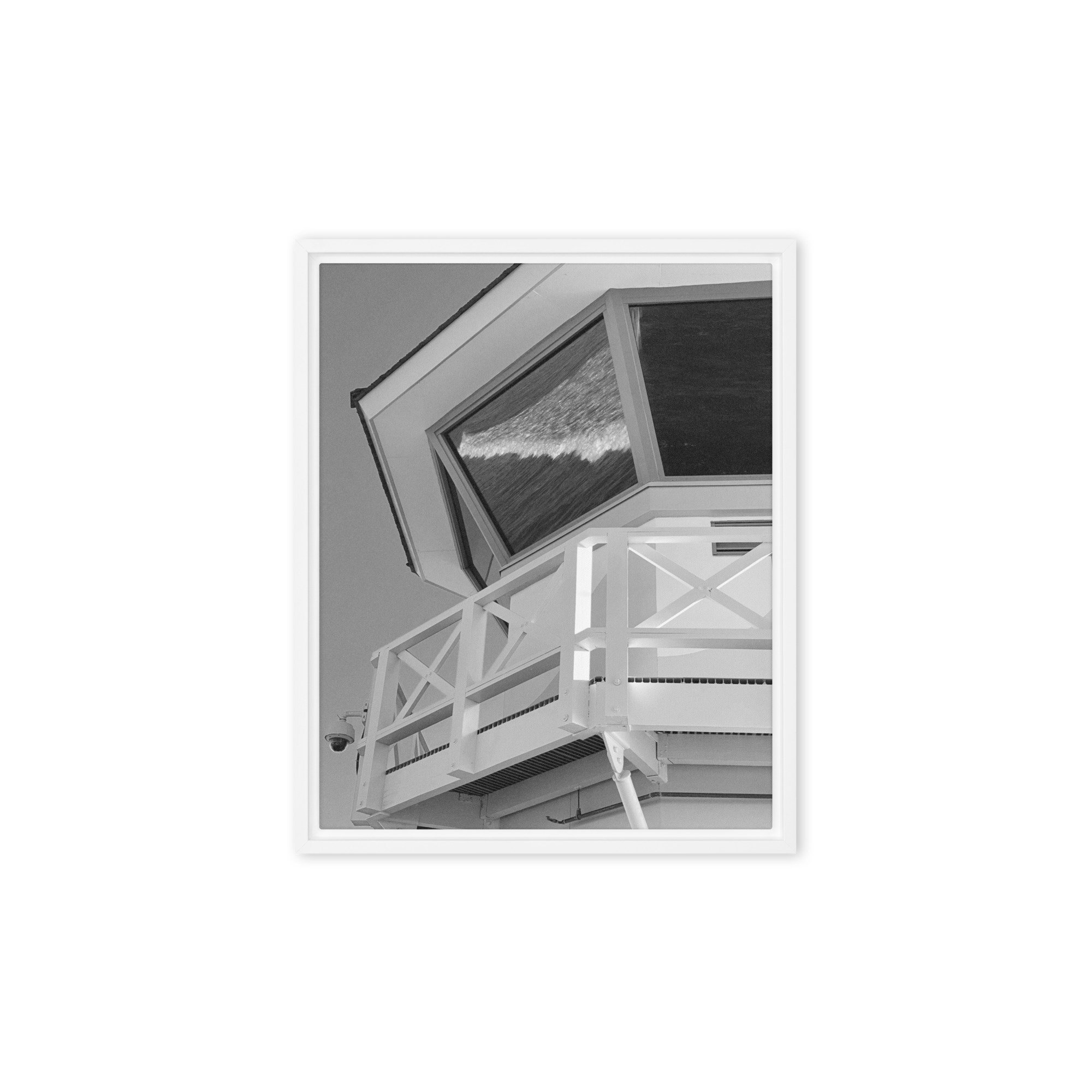
In "Beach Lifeguard Tower," Glen Wilbert photographs a California lifeguard tower from directly below, framing the angular underside of the structure against a plain sky, with a breaking wave reflected in the slanted glass of its window.
The image is rendered in black and white, which strips the tower down to its lines and planes: the diagonal of the roof, the X-braces of the railing, the louvered vents beneath the deck. Glen shot from close range and low, so the building reads less as a beach hut and more as a set of intersecting angles. The reflected wave in the window is the decisive detail, a curl of surf caught in the glass, placing the ocean inside the architecture without showing it directly.
Lifeguard towers are a fixture of the Southern California coastline and a recurring subject in Glen's beach work. Here the familiar structure is reframed as a study in geometry rather than a postcard of the shore.
In black and white, the composition is built on line and angle: the hard edges of the tower set against soft sky and reflected water.
Awards and Recognition
Glen Wilbert's work has earned national recognition, including First Place at the 2024 iPhone Photography Awards, multiple Gold Medals at the reFocus Awards, and selection for more than thirty juried exhibitions across the United States.
Details
• Framed canvas print, pine wood frame with a floating-frame effect
• Frame thickness: 1.25 in (3.18 cm)
• Canvas weight: approximately 344 g/m2
• White frame with a white inner border around the canvas
• Open back, rubber corner pads, hanging hardware attached
• Printed and framed in the USA
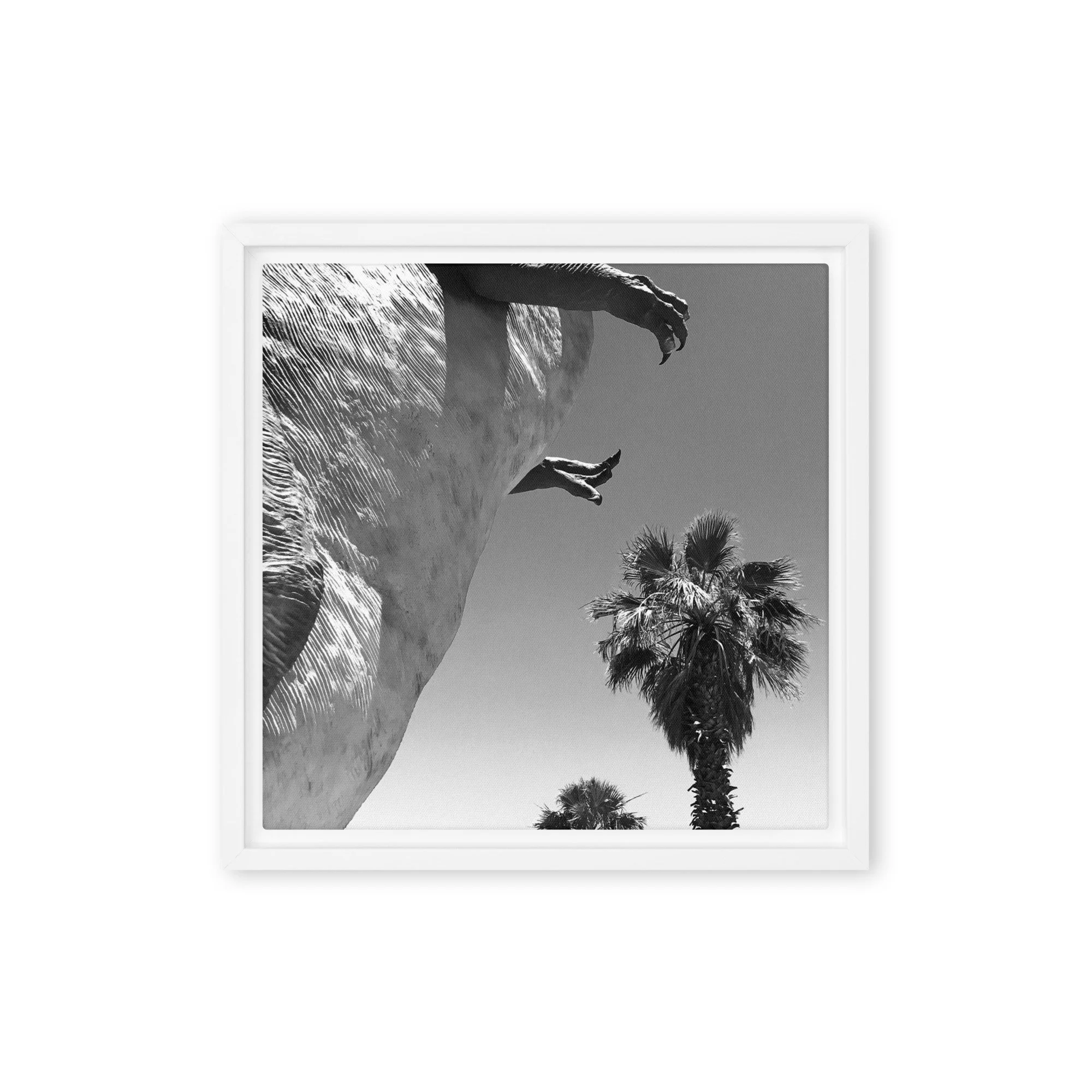
In "Cabazon California," Glen Wilbert photographs the underside of one of the giant Cabazon dinosaur sculptures, shooting steeply upward so that the creature's belly, foreleg, and clawed foot fill the upper frame against a clear sky, with two palm trees rising at the right.
The image is rendered in black and white, which turns the sculpture into a strong dark shape against the pale sky and emphasizes the textured, sculpted surface of its hide. Glen's low, tilted angle crops the dinosaur to a fragment, the leg and claw reaching across the frame, so the eye reads shape and gesture before it identifies the subject. The palms anchor the composition at lower right and place the scene firmly in the California desert.
The Cabazon Dinosaurs, near Palm Springs along Interstate 10, are a well-known piece of roadside Americana built in the 1960s. Glen photographs them not as a whole roadside attraction but as a cropped, graphic detail.
In black and white, the composition is built on silhouette and gesture: the dark, textured form of the sculpture against open sky.
Awards and Recognition
Glen Wilbert's work has earned national recognition, including First Place at the 2024 iPhone Photography Awards, multiple Gold Medals at the reFocus Awards, and selection for more than thirty juried exhibitions across the United States.
Details
• Framed canvas print, pine wood frame with a floating-frame effect
• Frame thickness: 1.25 in (3.18 cm)
• Canvas weight: approximately 344 g/m2
• White frame with a white inner border around the canvas
• Open back, rubber corner pads, hanging hardware attached
• Printed and framed in the USA
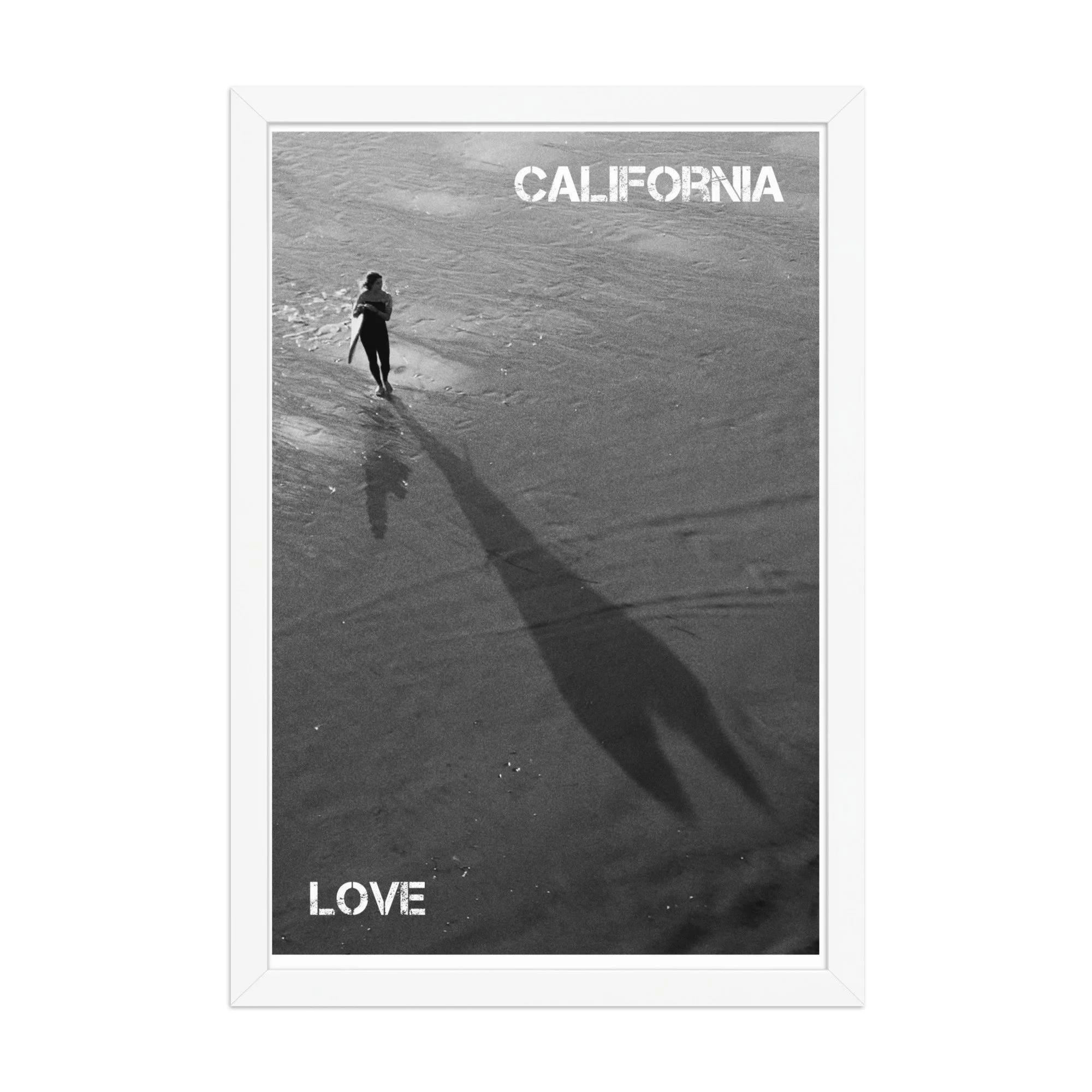
In "California Love," Glen Wilbert photographs a lone surfer crossing wet sand carrying a board, shot from high above so the figure casts a long shadow that stretches diagonally across the frame, with the words "CALIFORNIA" and "LOVE" set into the upper and lower corners. Glen captured the exact moment the shadow created the shape of a heart.
The image is rendered in black and white and composed as a poster, with the high overhead viewpoint turning the surfer and their shadow into the main graphic element against the broad expanse of dark, textured sand. The long shadow is the decisive feature, cutting across the composition and giving a single small figure a strong diagonal line. The stenciled text frames the image and gives it the feel of a vintage travel or surf poster.
The scene captures the everyday ritual of a California surfer walking the beach, treated with a graphic, design-forward sensibility. It connects directly to the When in Roam theme of California coastal culture.
In black and white, the composition is built on silhouette and shadow: a single figure and its long diagonal across open sand.
Awards and Recognition
Glen Wilbert's work has earned national recognition, including First Place at the 2024 iPhone Photography Awards, multiple Gold Medals at the reFocus Awards, and selection for more than thirty juried exhibitions across the United States.
Details
• Framed poster, printed on high-quality paper with a partly glossy, partly matte finish
• 10 mil (0.25 mm) thick paper, paper weight 260 g/m2
• 0.75 in (1.9 cm) thick ayous wood frame
• Acrylite front protector
• Hanging hardware included
• Blank product components in the US sourced from Japan and the US; in the EU sourced from Japan and Latvia
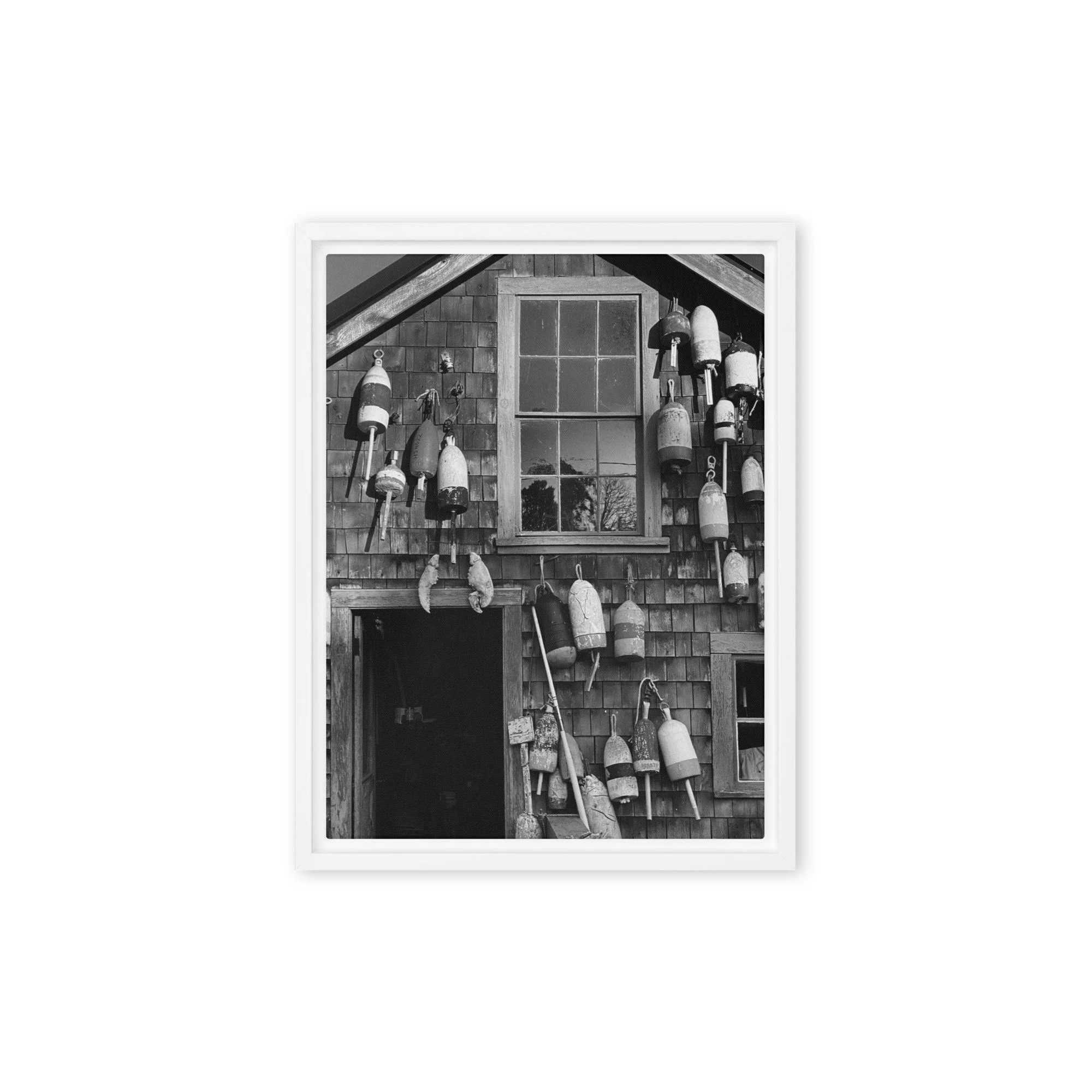
In "Maine," Glen Wilbert photographs the gable end of a weathered shingled fishing shack hung with lobster buoys, a paned window at the center and a dark open doorway below, with a pair of crab claws nailed above the door.
The image is rendered in black and white, which brings out the texture of the aged wood shingles and the worn paint on the hanging buoys. Glen framed the wall straight on so the buoys, the window, and the doorway arrange themselves into a loose grid across the surface, each buoy a slightly different shape and tone. The reflection of bare trees shows faintly in the window glass, and the crab claws over the door add an odd, specific detail.
This is a piece of New England coastal Americana, the working buoys and gear of a Maine lobster fishery left on the building as everyday decoration. Glen records it as an arrangement of found objects on a textured wall.
In black and white, the composition is built on texture and arrangement: worn buoys and shingles read as shape and tone.
Awards and Recognition
Glen Wilbert's work has earned national recognition, including First Place at the 2024 iPhone Photography Awards, multiple Gold Medals at the reFocus Awards, and selection for more than thirty juried exhibitions across the United States.
Details
• Framed canvas print, pine wood frame with a floating-frame effect
• Frame thickness: 1.25 in (3.18 cm)
• Canvas weight: approximately 344 g/m2
• White frame with a white inner border around the canvas
• Open back, rubber corner pads, hanging hardware attached
• Printed and framed in the USA
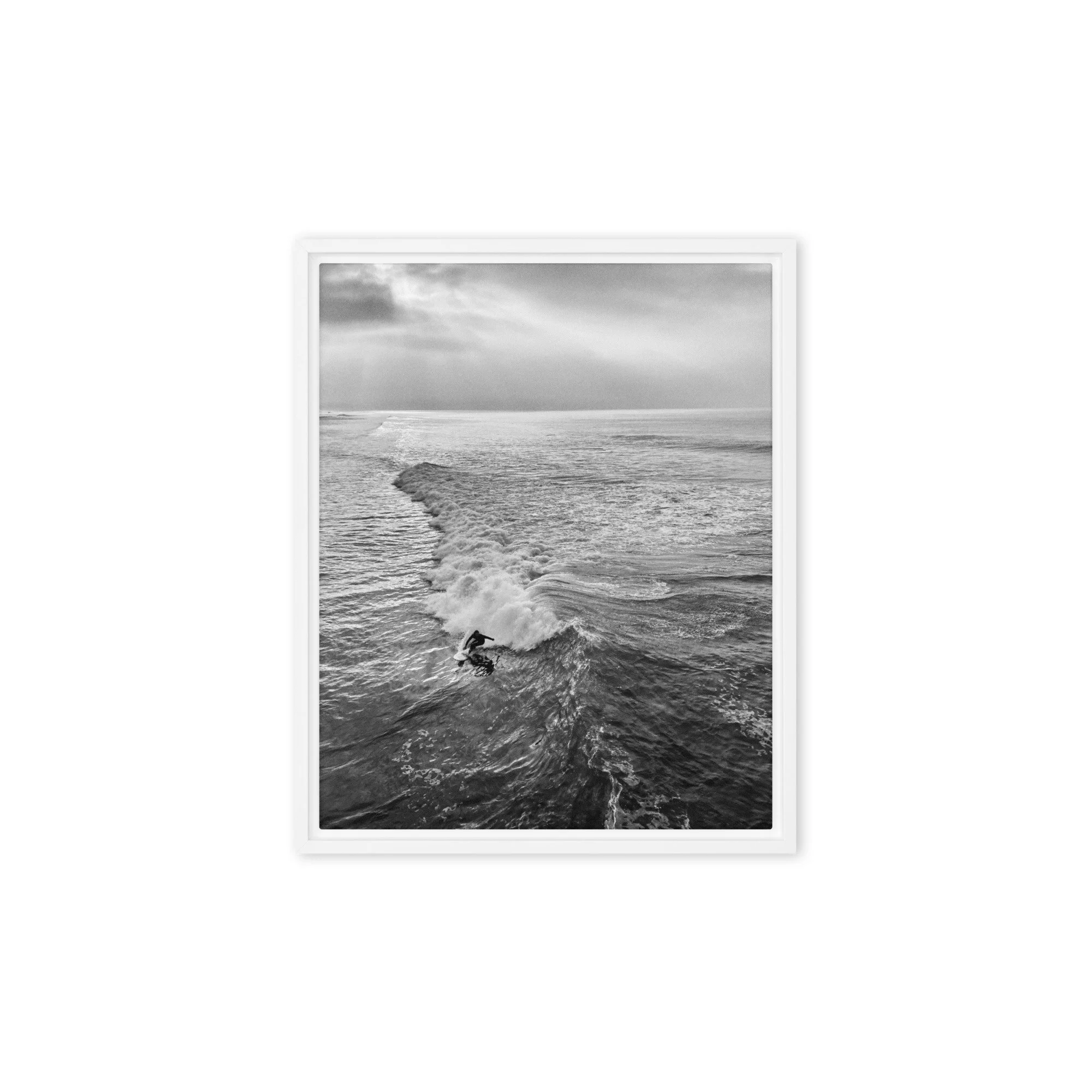
In "Last Ride Home, Southern California," Glen Wilbert photographs a lone surfer riding a breaking wave at dusk, shot from above so the figure and the white spray of the wave sit against a wide expanse of open, rippling sea.
The image is rendered in black and white, with the surfer reduced to a small dark shape trailing a burst of foam as the wave peels diagonally across the lower frame. Glen shot from a high vantage, likely a pier or drone, flattening the water into a field of soft grays and placing the single rider off-center against the heavy, cloud-streaked sky and silver horizon. The breaking wave is the one bright, active mark in an otherwise calm and open composition.
The scene captures a quiet end-of-day moment on the Southern California coast, a single surfer catching a final wave. It connects to the When in Roam theme of West Coast beach culture, here in a darker, more atmospheric register.
In black and white, the composition is built on scale and contrast: a small figure and a curl of white set against wide gray water.
Awards and Recognition
Glen Wilbert's work has earned national recognition, including First Place at the 2024 iPhone Photography Awards, multiple Gold Medals at the reFocus Awards, and selection for more than thirty juried exhibitions across the United States.
Details
• Framed canvas print, pine wood frame with a floating-frame effect
• Frame thickness: 1.25 in (3.18 cm)
• Canvas weight: approximately 344 g/m2
• White frame with a white inner border around the canvas
• Open back, rubber corner pads, hanging hardware attached
• Printed and framed in the USA
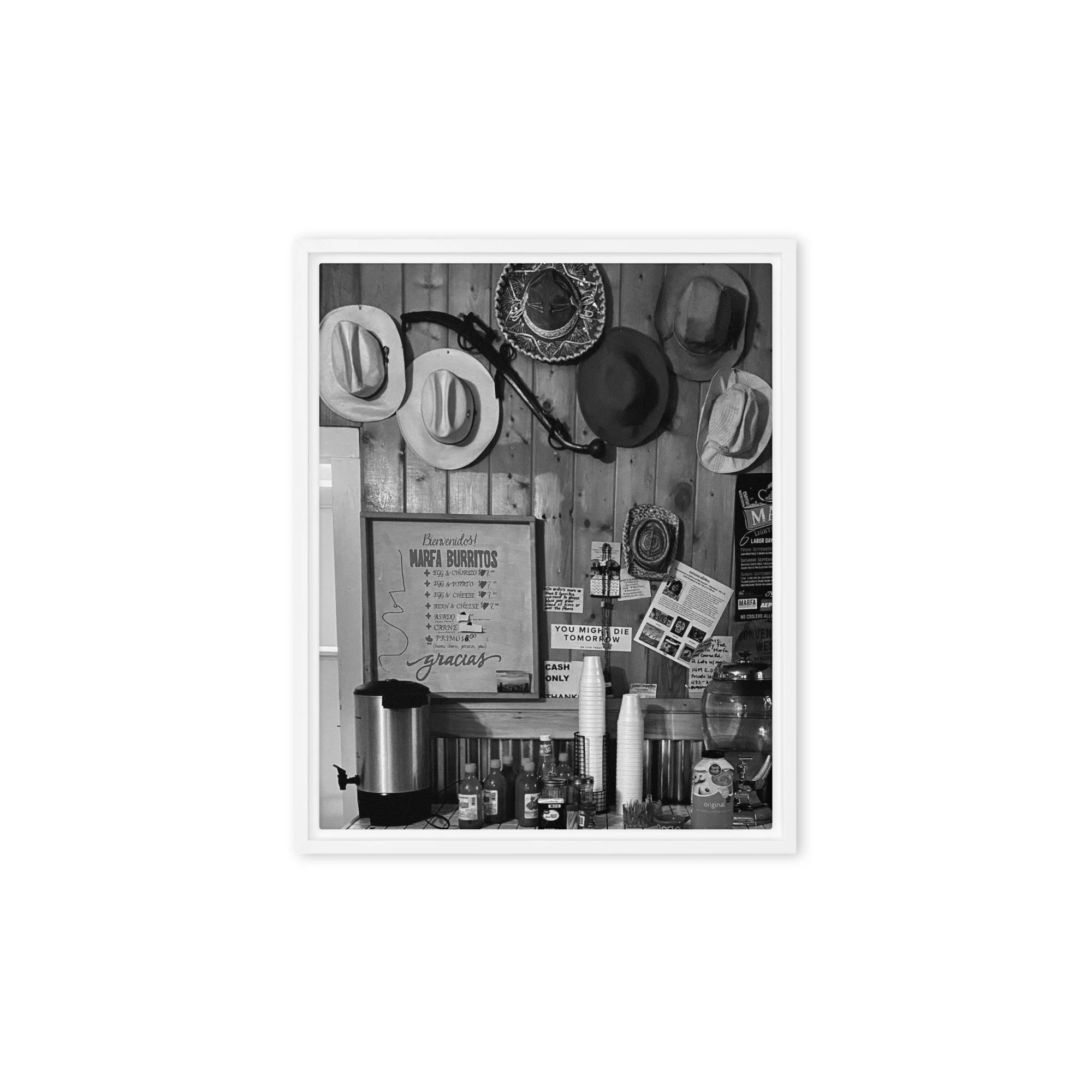
In "Marfa Burrito, Texas," Glen Wilbert photographs the interior wall of the well-known Marfa Burrito eatery, where a row of cowboy hats and a sombrero hang above a hand-lettered menu board, a coffee urn, stacked cups, and a counter of condiments.
The image is rendered in black and white, which unifies the crowded scene and emphasizes the wood paneling, the felt and straw of the hats, and the handwriting on the "Marfa Burritos" sign. Glen framed the wall straight on so the hats line up across the top like a header and the menu, taped notes, and counter clutter fill the lower half. Small details reward a closer look, including a taped card that reads "you might die tomorrow." The picture captures the specific, lived-in character of the place.
Marfa, in the high desert of West Texas, is a small town known both for its minimalist art installations and for unpretentious local spots like this one. The image sits squarely in Glen's road-trip Americana.
In black and white, the composition is built on arrangement and detail: hats, signage, and counter objects read as a single textured wall.
Awards and Recognition
Glen Wilbert's work has earned national recognition, including First Place at the 2024 iPhone Photography Awards, multiple Gold Medals at the reFocus Awards, and selection for more than thirty juried exhibitions across the United States.
Details
• Framed canvas print, pine wood frame with a floating-frame effect
• Frame thickness: 1.25 in (3.18 cm)
• Canvas weight: approximately 344 g/m2
• White frame with a white inner border around the canvas
• Open back, rubber corner pads, hanging hardware attached
• Printed and framed in the USA
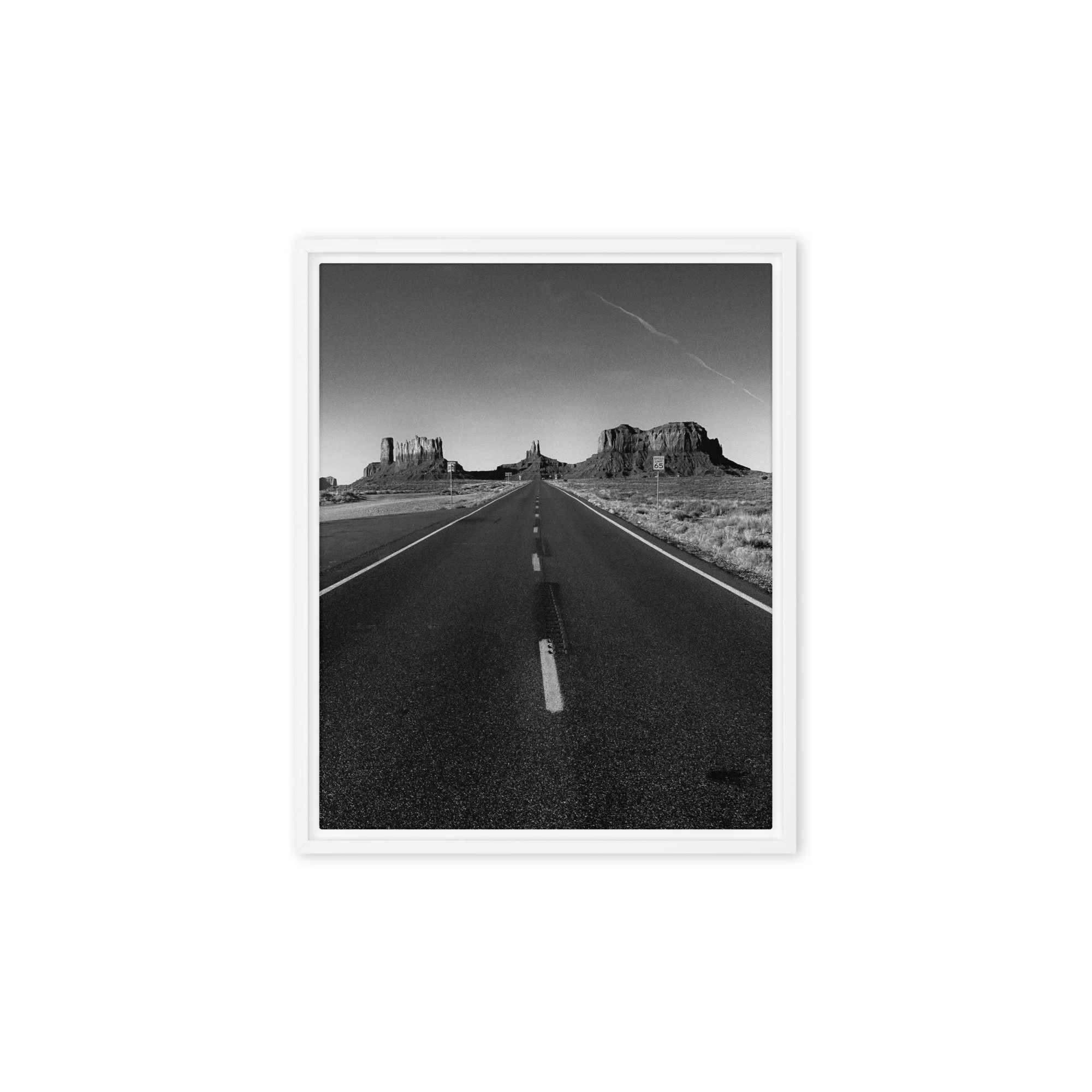
In "Moab," Glen Wilbert photographs an empty two-lane highway running straight away from the camera toward the distant buttes of Monument Valley, the dashed center line drawing the eye to the horizon under a clear, dark sky.
The image is rendered in black and white, with the dark asphalt filling the foreground and the painted center line leading sharply to a vanishing point between the rock formations. Glen stood in the center of the road and shot low and straight so the highway becomes a strong central axis, the mittens and mesas of the valley rising small on either side of the horizon and a single thin contrail marking the sky. The deep tonal range, from black road to bright sky, gives the picture its graphic strength.
This stretch of highway near the Utah-Arizona border, on the approach to Monument Valley, is one of the most iconic road-trip views in the American West. It is a defining image for the When in Roam project and its road-trip theme.
In black and white, the composition is built on line and perspective: a single road running straight to the buttes on the horizon.
Awards and Recognition
Glen Wilbert's work has earned national recognition, including First Place at the 2024 iPhone Photography Awards, multiple Gold Medals at the reFocus Awards, and selection for more than thirty juried exhibitions across the United States.
Details
• Framed canvas print, pine wood frame with a floating-frame effect
• Frame thickness: 1.25 in (3.18 cm)
• Canvas weight: approximately 344 g/m2
• White frame with a white inner border around the canvas
• Open back, rubber corner pads, hanging hardware attached
• Printed and framed in the USA
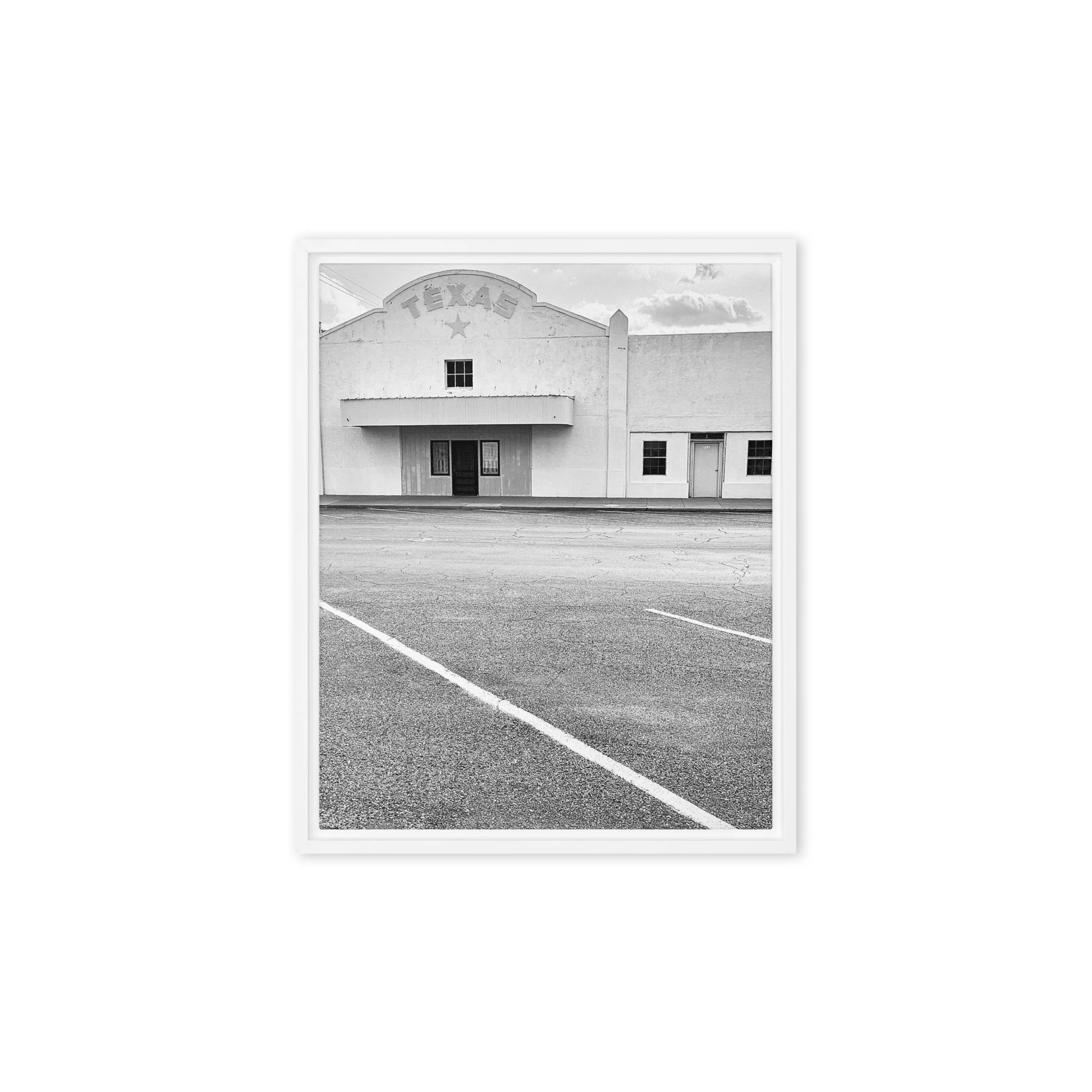
In "Marfa, Texas," Glen Wilbert photographs a low white building with the word "TEXAS" and a lone star across its arched facade, set back across a wide, empty asphalt lot marked with painted parking lines.
The image is rendered in black and white and built on open space, with the cracked, pale parking lot filling most of the lower frame and the single-story building running along the horizon beneath a big sky. Glen framed the scene straight on and low so the white painted parking stripe leads in from the foreground and the building sits small and centered, its arched parapet and star the only ornament. The emptiness of the lot is as much the subject as the building itself.
Marfa is a remote town in the West Texas desert, known for its blend of ranching culture and minimalist art. The quiet, vacant composition recalls the deadpan roadside photography of Ed Ruscha.
In black and white, the composition is built on emptiness and line: a small marked facade set across a wide bare lot.
Awards and Recognition
Glen Wilbert's work has earned national recognition, including First Place at the 2024 iPhone Photography Awards, multiple Gold Medals at the reFocus Awards, and selection for more than thirty juried exhibitions across the United States.
Details
• Framed canvas print, pine wood frame with a floating-frame effect
• Frame thickness: 1.25 in (3.18 cm)
• Canvas weight: approximately 344 g/m2
• White frame with a white inner border around the canvas
• Open back, rubber corner pads, hanging hardware attached
• Printed and framed in the USA
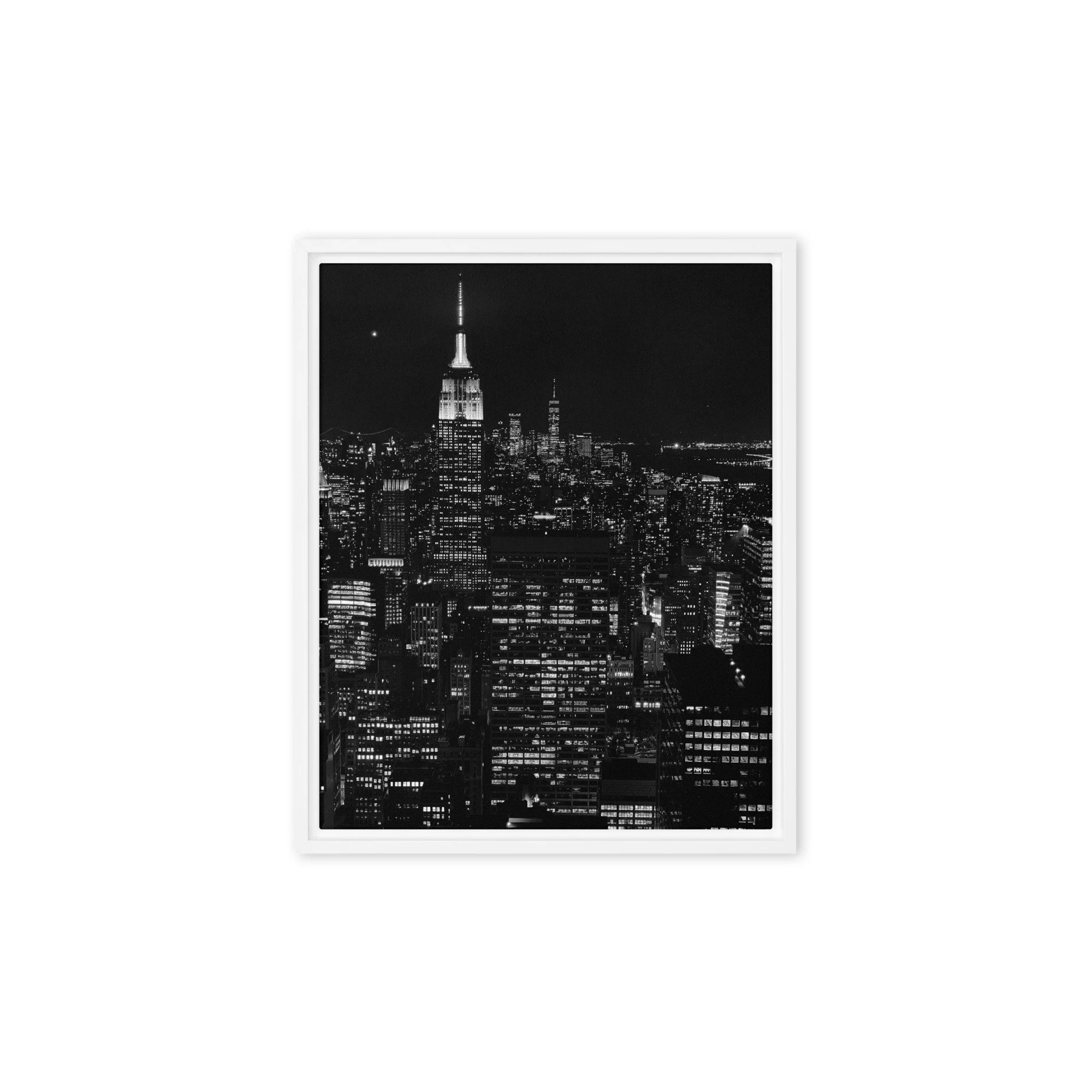
In "Nightlights, NYC," Glen Wilbert photographs the Manhattan skyline after dark, the illuminated spire of the Empire State Building rising above a dense field of lit windows, with the moon hanging in the black sky to its left.
The image is rendered in black and white and built almost entirely from points of light against deep shadow, the towers reading as dark masses pierced by grids of bright windows. Glen framed the Empire State Building off-center near the top so its lit crown and antenna anchor the composition, while the lower city dissolves into a scatter of smaller lights stretching to the harbor. The high contrast between the black sky and the white lights gives the picture its graphic structure, and the small moon adds a single quiet detail above the skyline.
This elevated view of midtown and lower Manhattan is one of the most familiar nightscapes in the world. Glen treats it as a study in light and dark rather than a sweeping panorama.
In black and white, the composition is built on light and shadow: bright windows and a lit tower set against a field of black.
Awards and Recognition
Glen Wilbert's work has earned national recognition, including First Place at the 2024 iPhone Photography Awards, multiple Gold Medals at the reFocus Awards, and selection for more than thirty juried exhibitions across the United States.
Details
• Framed canvas print, pine wood frame with a floating-frame effect
• Frame thickness: 1.25 in (3.18 cm)
• Canvas weight: approximately 344 g/m2
• White frame with a white inner border around the canvas
• Open back, rubber corner pads, hanging hardware attached
• Printed and framed in the USA
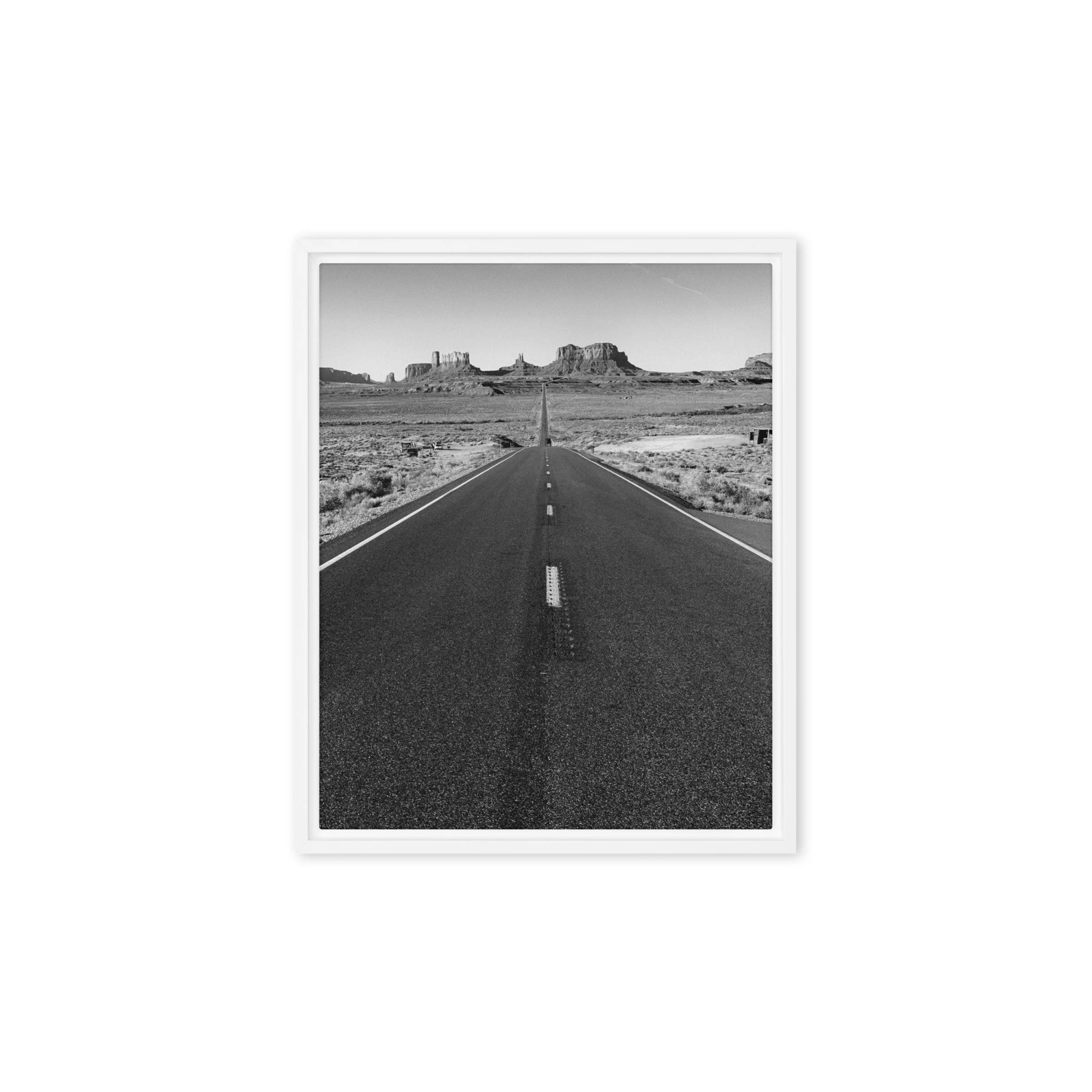
In "Monument Valley," Glen Wilbert photographs the long approach highway to Monument Valley, the two-lane road running straight from the foreground to a far rise where the buttes and mesas line the horizon under a wide, clear sky.
The image is rendered in black and white, with the dark road and its dashed center line drawing the eye from the bottom of the frame to the distant rock formations. Glen shot from the center of the highway so the lanes taper to a point near the horizon, the scrub-dotted desert spreading flat on either side and the iconic buttes clustered small along the skyline. The deep tonal range, from black asphalt to pale sky, gives the picture its graphic clarity. A faint contrail crosses the upper sky.
This view, on the highway approaching the Utah-Arizona border, is one of the most recognized road-trip scenes in the American West. It is a central image for the When in Roam project and its open-road theme.
In black and white, the composition is built on line and perspective: a single road tapering toward the buttes on the horizon.
Awards and Recognition
Glen Wilbert's work has earned national recognition, including First Place at the 2024 iPhone Photography Awards, multiple Gold Medals at the reFocus Awards, and selection for more than thirty juried exhibitions across the United States.
Details
• Framed canvas print, pine wood frame with a floating-frame effect
• Frame thickness: 1.25 in (3.18 cm)
• Canvas weight: approximately 344 g/m2
• White frame with a white inner border around the canvas
• Open back, rubber corner pads, hanging hardware attached
• Printed and framed in the USA
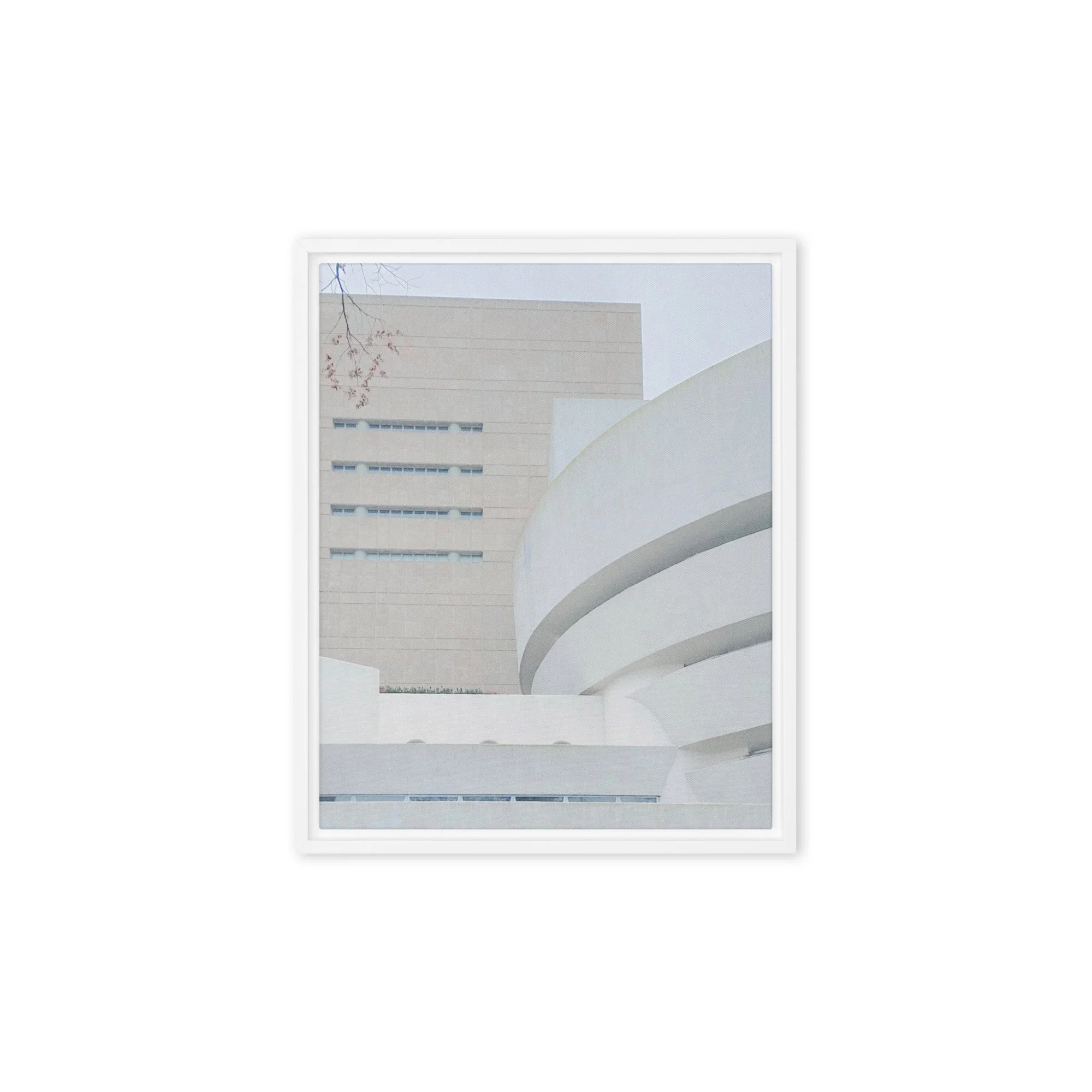
In "Spring, NYC," Glen Wilbert photographs the Solomon R. Guggenheim Museum in New York, framing the smooth curved coils of its spiral facade beside the flat grid of an adjacent building, with a single bare branch in early bloom hanging into the upper left of the frame.
The image is rendered in a very high-key black and white, almost white on white, so the rounded forms of the Guggenheim read as soft gradations of pale gray rather than hard edges. Glen set the museum's sweeping curves against the regular windows and straight lines of the neighboring tower, contrasting organic and rectilinear architecture. The thin dark branch with its few small blossoms is the one delicate element, marking the season and giving the title its meaning.
The Guggenheim, designed by Frank Lloyd Wright on Fifth Avenue, is one of the most recognized works of modern architecture in the world. Glen photographs it as a near-abstract study of curve against grid.
In black and white, the composition is built on curve and contrast: the soft spiral of the museum set against a flat window grid.
Awards and Recognition
Glen Wilbert's work has earned national recognition, including First Place at the 2024 iPhone Photography Awards, multiple Gold Medals at the reFocus Awards, and selection for more than thirty juried exhibitions across the United States.
Details
• Framed canvas print, pine wood frame with a floating-frame effect
• Frame thickness: 1.25 in (3.18 cm)
• Canvas weight: approximately 344 g/m2
• White frame with a white inner border around the canvas
• Open back, rubber corner pads, hanging hardware attached
• Printed and framed in the USA
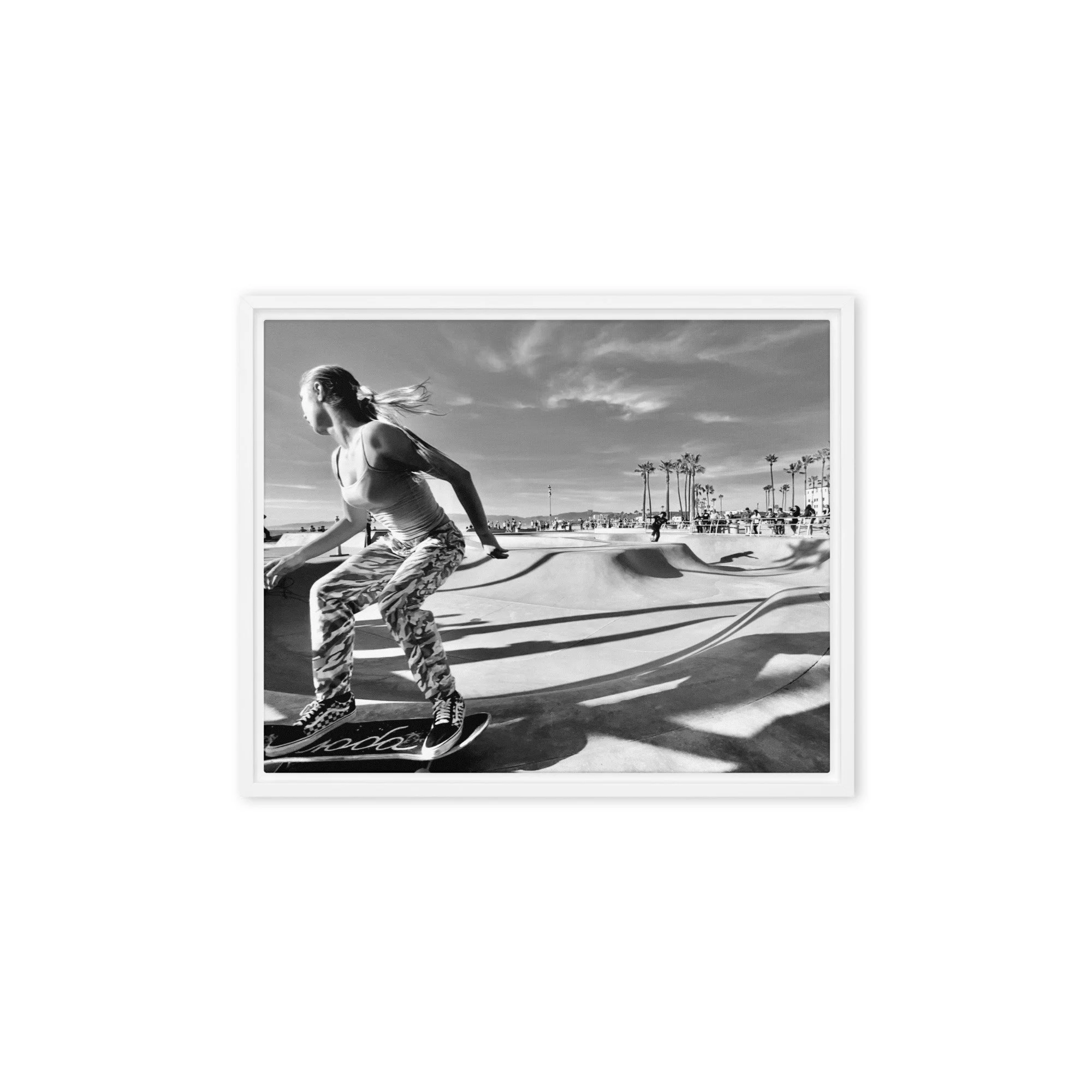
In "Venice Beach in Black and White," Glen Wilbert photographs a skateboarder carving low through the concrete bowls of the Venice Beach Skatepark, hair streaming and arms out for balance, with palms, onlookers, and long afternoon shadows behind.
The image is rendered in black and white, with strong sunlight raking across the skater and the smooth gray sweeps of the skate bowl. Glen shot from close and slightly low so the rider fills the left of the frame in sharp detail while the curved concrete and the dark shadows of palm trees stretch across the right. The streaked sky and distant crowd set the scene, but the picture stays focused on the skater's crouched, mid-carve stance, the decisive moment of the run.
The Venice Beach Skatepark, on the Los Angeles oceanfront, is one of the most famous skate spots in the world. This is the closer, action-focused companion to Glen's other Venice skate image, trading the wide airborne view for an intimate study of motion and balance.
In black and white, the composition is built on gesture and contrast: a single carving figure set against bright concrete and dark shadow.
Awards and Recognition
Glen Wilbert's work has earned national recognition, including First Place at the 2024 iPhone Photography Awards, multiple Gold Medals at the reFocus Awards, and selection for more than thirty juried exhibitions across the United States.
Details
• Framed canvas print, pine wood frame with a floating-frame effect
• Frame thickness: 1.25 in (3.18 cm)
• Canvas weight: approximately 344 g/m2
• White frame with a white inner border around the canvas
• Open back, rubber corner pads, hanging hardware attached
• Printed and framed in the USA
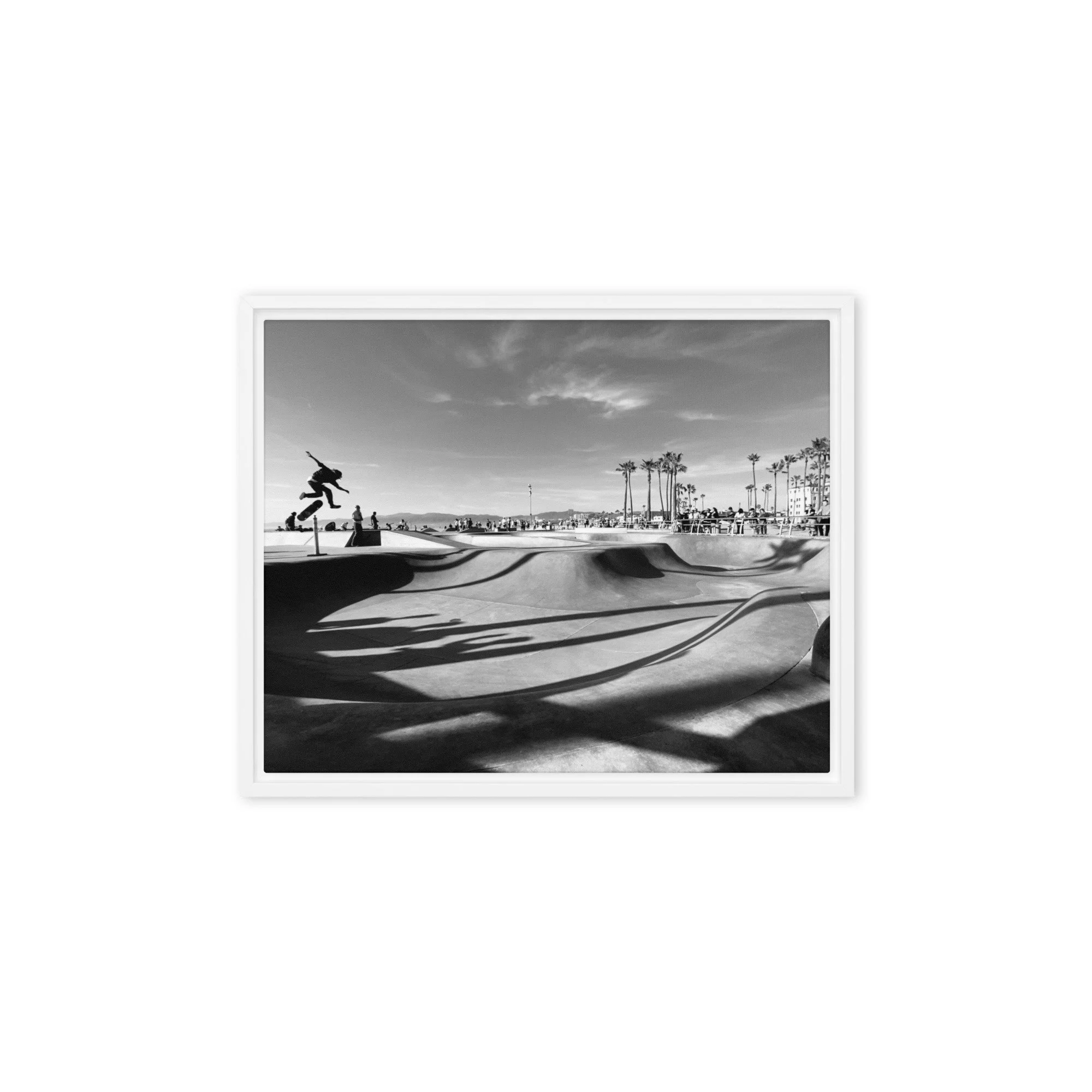
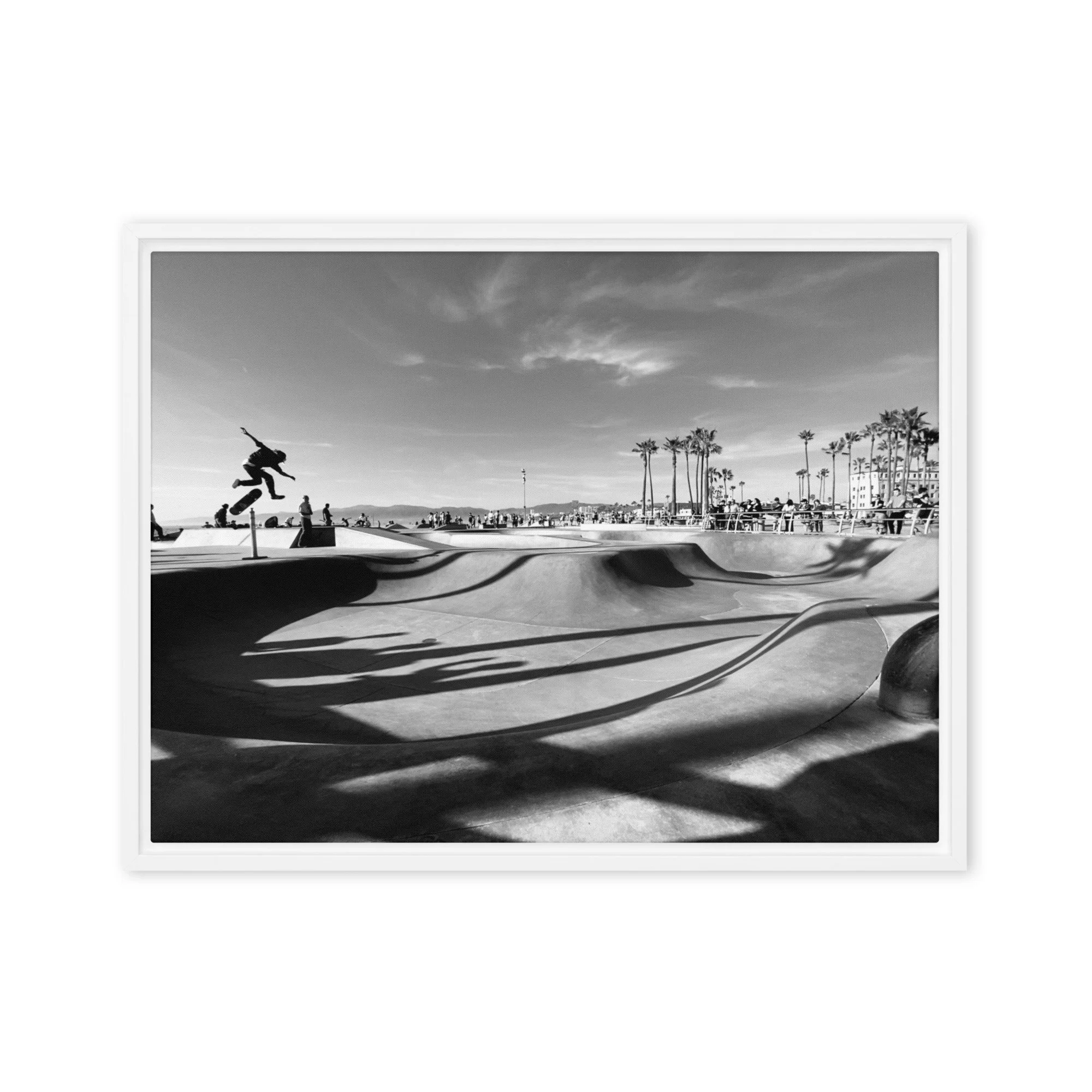
"In ""Learning To Fly, Venice Beach,"" Glen Wilbert photographs a skateboarder caught at the top of a jump above the curved concrete bowls of the Venice Beach Skatepark, with palm trees, onlookers, and the flat coastline stretching behind.
The image is rendered in black and white, with the smooth gray sweeps of the skate bowls filling the foreground and the lone airborne skater silhouetted against the bright sky at the upper left. Glen shot low and wide so the curved walls of the park curl across the frame and the long shadows of the palms fall in dark diagonal strokes over the concrete. The skater, frozen with arms out and board underfoot, is the decisive moment the picture is built around.
The Venice Beach Skatepark, on the oceanfront in Los Angeles, is one of the most famous public skate spots in the world. Glen frames it as a study of curved form and arrested motion rather than an action shot.
In black and white, the composition is built on curve and contrast: the sweeping concrete and dark shadows against a single figure in the air.
Awards and Recognition
Glen Wilbert's work has earned national recognition, including First Place at the 2024 iPhone Photography Awards, multiple Gold Medals at the reFocus Awards, and selection for more than thirty juried exhibitions across the United States.
Details
• Framed canvas print, pine wood frame with a floating-frame effect
• Frame thickness: 1.25 in (3.18 cm)
• Canvas weight: approximately 344 g/m2
• White frame with a white inner border around the canvas
• Open back, rubber corner pads, hanging hardware attached
• Printed and framed in the USA"
In "Crosswalk," Glen Wilbert photographs a lone surfer walking across a wide beach carrying a board, shot from above so the figure sits small in the frame while overlapping tire tracks curve across the sand around him, with a hazy line of palm trees along the horizon.
The image is rendered in black and white, the pale sand and misty background nearly bleaching out while the dark tire ruts and the surfer's silhouette hold the eye. Glen shot from a high vantage that flattens the beach into a soft gray field, so the crossing arcs of tire tracks read as a network of curved lines drawn across it. The surfer, small and dark near the center, sits exactly at the intersection of several tracks, a single moving figure caught among the traces of everything that has already passed.
The scene is an early-morning moment on the Southern California coast, the beach still foggy and marked by the passes of overnight patrol and cleaning vehicles. It fits directly into Glen's ongoing California surf and coastal work.
In black and white, the composition is built on pattern and gesture: sweeping curved tracks across pale sand and a single figure crossing them.
Awards and Recognition
Glen Wilbert's work has earned national recognition, including First Place at the 2024 iPhone Photography Awards, multiple Gold Medals at the reFocus Awards, and selection for more than thirty juried exhibitions across the United States.
Details
Framed canvas print, pine wood frame with a floating-frame effect
Frame thickness: 1.25 in (3.18 cm)
Canvas weight: approximately 344 g/m2
White frame with a white inner border around the canvas
Open back, rubber corner pads, hanging hardware attached
Printed and framed in the USA